Take Your Strategy Apart Before the Market Does
How well could your organization cope with a future it has discussed many times, but never actually rehearsed?
That is the question behind the VSM Strategy Game. Over five intense days, you and your colleagues work on your own organization: map its environment, examine how the business is segmented, design a steering system, and see how it responds when conditions change.
By steering system, I mean something quite concrete: who notices changes, who makes which decisions, how resources are negotiated, how conflicts between units are resolved, and how the organization learns. The Viable System Model provides the underlying logic for this work.
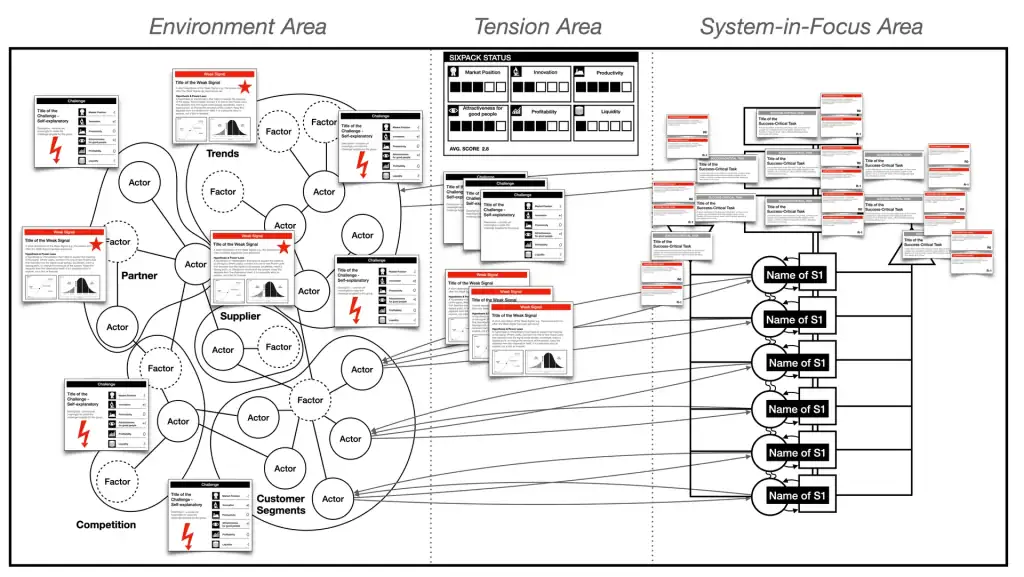
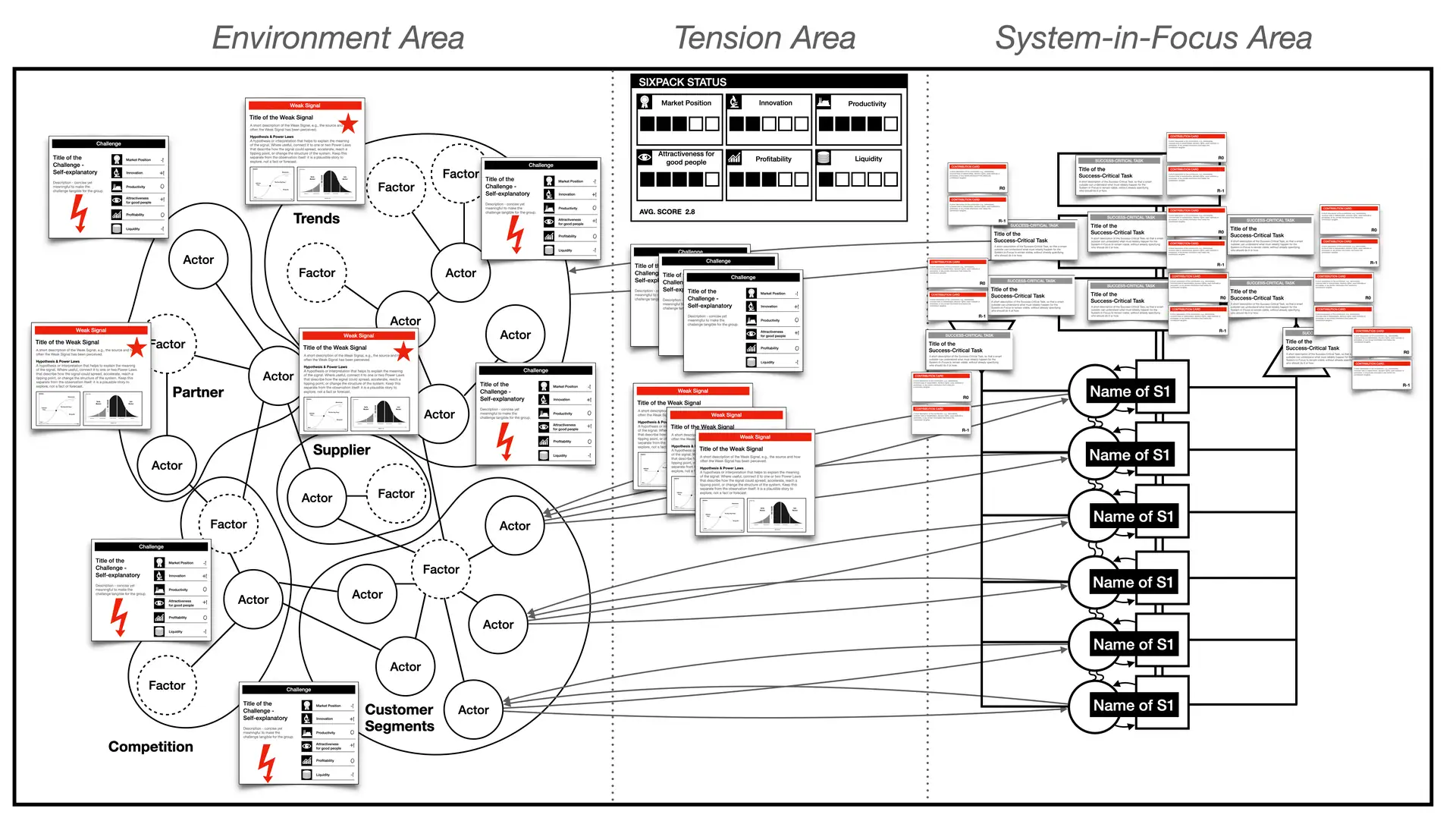
The board grows throughout the game, connecting the external environment with operative units and the steering system.
What is the purpose?
The aim is to develop a shared understanding of what the organization needs to remain viable. Where are we blind? Which assumptions are we quietly relying on? Can our operative units respond to their markets? Where does coordination help, and where does it get in the way?
These questions become tangible through a growing game board, Challenge Cards, weak signals, and scenarios. Players have to respond through the steering arrangements they have designed. A vague promise to “collaborate more closely” becomes rather less convincing when several units need the same scarce resource.
Five days, plus preparation
In the introduction, I describe the format as “an ideal path through five very intense days.” The sample timetable runs from 08:30 to 18:30, including breaks. Preparation comes on top.
That is a serious commitment. The handbook sketches an ambitious reference format that needs to be adapted to what an organization can realistically digest. Some elements can be simplified, spread across sessions, or replaced with practices that serve the same purpose. The VSM remains the foundation.
The suggested group is around eight to twelve players, bringing together operations, customers and markets, technology, finance, and people. Include colleagues close enough to customers or delivery to notice what others miss. An experienced facilitator acts as Game Master; some practical familiarity with VSM is very helpful.
Before the game, the Game Master conducts focused interviews of 30–45 minutes each with the sponsor, two to four key players, and one or two people at the edges of the organization. Light desk research complements these conversations. The result is an initial picture of the environment, a Sixpack of Control baseline, and five to fifteen candidate challenges.
The handbook does not set a fixed total preparation budget. Research, synthesis, room setup, and preparing the materials require time beyond the interviews. How much depends on the scope and on what useful material already exists.
The phases
Phase 0: Prepare the ground
Define the organization or business area under examination, its boundaries, the time horizon, and the questions the game should help answer. Bring together the players, agree the ground rules, and prepare the initial material.
Phase 1: Model your environment
Build a shared picture of the actors and forces around the business. Explore how they interact, turn relevant developments into Challenge Cards, and look for weak signals. The map can be simple or more elaborate, depending on what the group can use productively.

Phase 1 turns external forces into a shared environment map
and a set of Challenge Cards.
Phase 2: Define operative units and check manageability
Explore how the business could be segmented into operative units, the S1 units in VSM. Assess the options against customer buying criteria and strategic priorities. Then ask whether management and coordination can actually handle the resulting complexity. Connect each unit’s environmental demands to the steering work it needs.
Phase 3: Design the steering system
Define the Success-Critical Tasks: recurring work that keeps the organization functioning and adapting. Decide what belongs close to operations, what needs to be shared, and what must be held centrally. Make accountability explicit and place the tasks within the VSM.
Phase 4: Play scenarios and check robustness
Expose the design to up to five scenarios. A competitor changes the market, a supplier becomes unreliable, or rapid growth stretches delivery capacity. Challenge Cards drive the rounds; weak signals can enter as wild cards. What held, what bent, and what broke?

A Challenge Card makes an external development concrete
and links it to the Sixpack of Control.
Phase 5: Make a judgement and define next steps
Choose the scenario the group currently considers most likely, making the assumptions and remaining uncertainty visible. Derive the implications for the steering system, shape a coherent target picture, and agree the first moves, their owners, and what still needs clarification.
What should remain after the game?
A shared environment map, explicit challenges, a reasoned segmentation, a steering model examined through scenarios, and concrete next steps. The Sixpack of Control keeps attention on market position, innovation, productivity, attractiveness for good people, profitability, and liquidity throughout the exercise.

The Sixpack of Control provides a shared view of the business dimensions affected during scenario play.
An AI companion supports documentation and scenario preparation. It captures the work so colleagues can revisit the reasoning afterwards. The people at the table remain responsible for the judgements and decisions.
Why a public beta?
Because the concept still needs to prove itself in practice. It draws on practical experience and several years of thinking, but the complete format has not yet been field-tested. Five days may turn out to be too ambitious. Some exercises may need a different rhythm.
This version focuses on business enterprises and their formal steering arrangements. NGOs, public sector organizations, and a deeper treatment of informal organization and culture need further work.
I am publishing the handbook to invite that work. If you try the game, adapt it, or find a weak spot, I would like to hear what happened. Where did it help the group think? Where did it become cumbersome? What would you change?
Download the public beta handbook below. It is published under Creative Commons Attribution Share Alike.